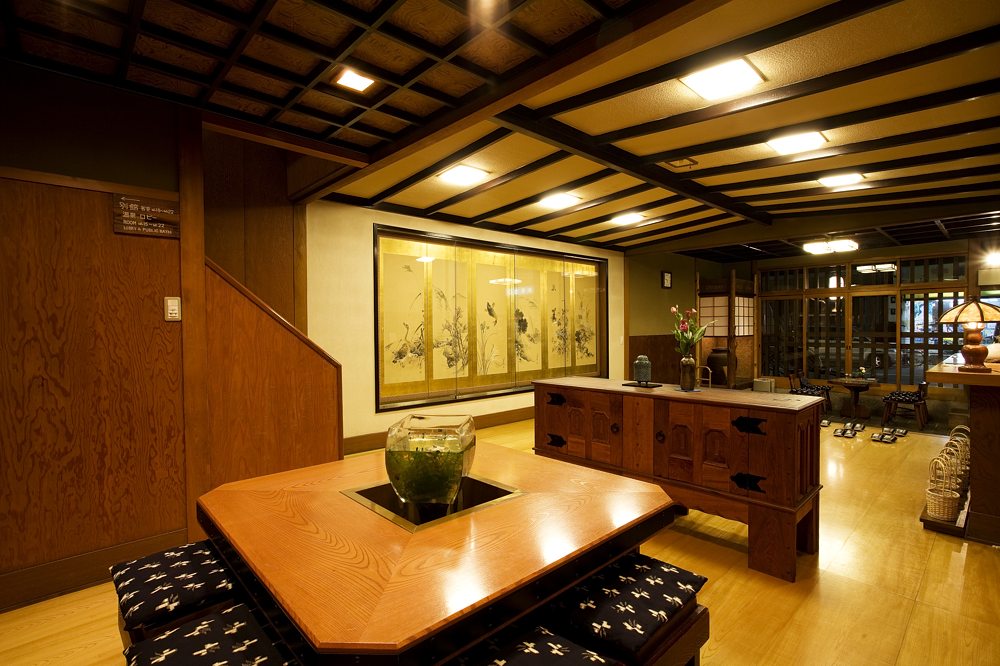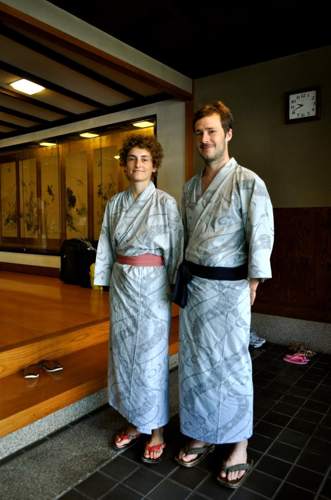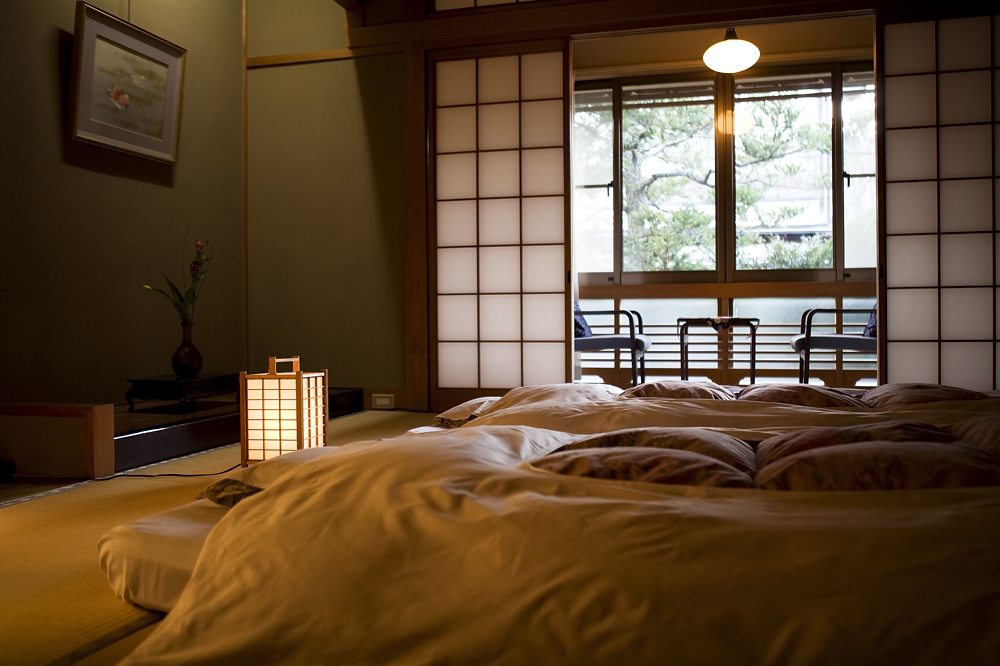
| Front Lobby |
 |
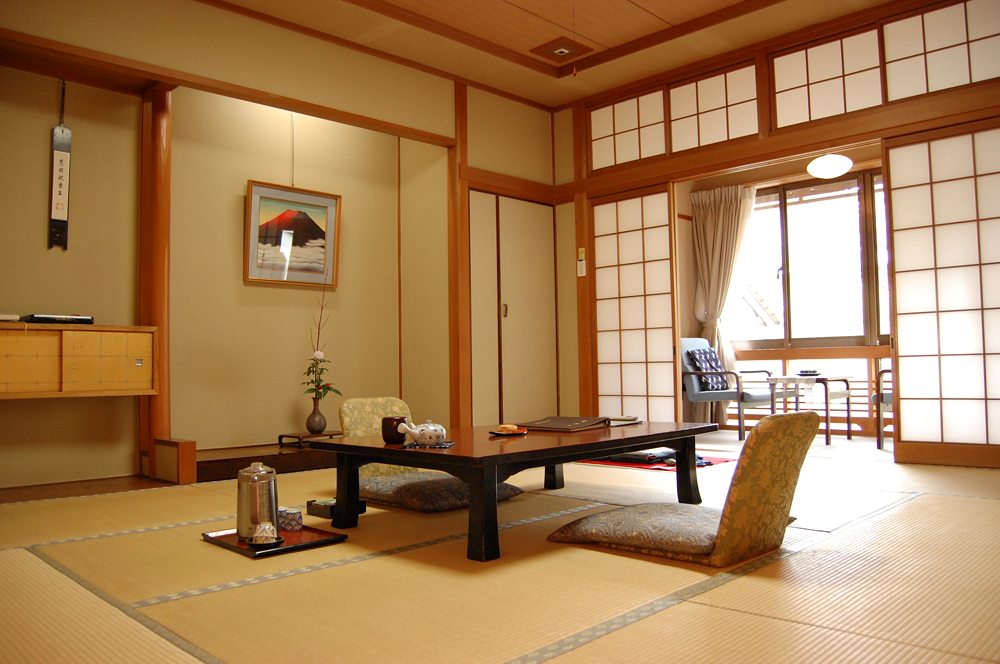
| Japanese Guest Room |
 |
The water in Kinosaki is renowned
for its
restorative effects. Among its
more major
benefits are:
Relieving the symptoms of joint
stiffness
brought on by rheumatism.
Relieves muscle stiffness caused by injury
or overwork.
Reducing stiff shoulder, "office syndrome".
Reducing RSI pain.
Reducing the pain of bruises.
Improving blood circulation.
Improving skin tone.
Making you feel generally warm, relaxed and
comfortable.
|
Garden View Public Bath |
  |
 |
| Post-bath relaxing area ->. |
Oil massage

A: Mikuniya special course 45min \5,000
(Face / Shoulder / Legs / Hands)
B: Shoulder&back course 45min \6,000
(shoulder / back / waist / arm / hand)
C: Facial course 60min \8,500
(Face / Shoulder)
D: Body course 80min \10,500
(shoulder / back / foot / waist / arm / hand)
E: Full Body couse 100min \13,500
(Face /shoulder / back / foot / waist / arm / hand)
Taking an "Ofuro", a Japanese bath.
Many overseas people balk at the idea of
bathing publicly, for reasons of shyness
or concerns about health and cleanliness.
Although travelers must indeed bathe in
nothing but their birthday suit and with only
a flannel (face-cloth) for modesty, at least
one need not be worried about hygiene. Because:
Before entering a bath, a person must already
be completely clean.
Indeed, it is taboo to enter
a Japanese bath
when dirty.
Although it sounds odd at first, it makes
sense, as baths are purely for relaxation, recuperation and
recreation. The actual business
of cleaning happens around the outside of
the bathroom.
A Japanese person will either just have had a shower at home, leaving them
needing nothing more than a few splashes
of water to remove any final traces of dirt,
or they will have made use of the on-site
cleaning facilites first.
Surrounding any Ofuro, one will usually find
an array of taps and small bowls. In modern Ofuros, you are also provided with the "luxury"
of a seat a shower and warm water! One goes about cleaning
oneself here. Bringing a face-towel, a Japanese
person will shower and rinse before soaping
up and thoroughly scrubbing down head to
toe to remove any dirt. Hair
is usually shampooed, and one might
also wish to shave at this point too.
After a final thorough rinse to remove any soap and shampoo from
one's body and especially from the flannel,
one is ready to enter the bath.
Don't be bashful. On any posters you may
have seen, the bathers will probably have
been wearing towels; this was purely for
printability's sake! Japanese are far less
concerned about nudity than their western
counterparts seem to be and thus bathe nude.
It is considered bad form to submerse one's
flannel in bath water
Japanese bathers will leave theirs on the
side of the bath, or place it over their
heads when using ro-ten-buro (outdoor baths),
but rarely submerse it.
The water in an ofuro is usually very hot (between 40 and 43 degrees) so prolonged bathing is usually
not possible, lasting only five to ten minutes
or so before cooling off in the showers.
Locals can linger
longer, as
they will have become seemingly immune
to the sizzling temperatures.
Also, for very obvious reasons, it is generally
forbidden to enter public baths with a cold,
flu or other contagious illnesses.
No stay in Japan is complete without a good
bathe in a relaxing Ofuro. Onsens (hot-springs)
are especially prized because of their wonderful
mineral water and the numerous health enhancing
effects that they bring.
Enjoy.
Craig Lloyd, Jan 2000.
 |
Mikuniya Ryokan,
221 Yushima, Kinosaki-cho,
Toyooka-shi, Hyogo-ken,
JAPAN 〒669-6101
TEL 0796-32-2414
FAX 0796-32-2679
mikuniya@mxa.nkansai.ne.jp |